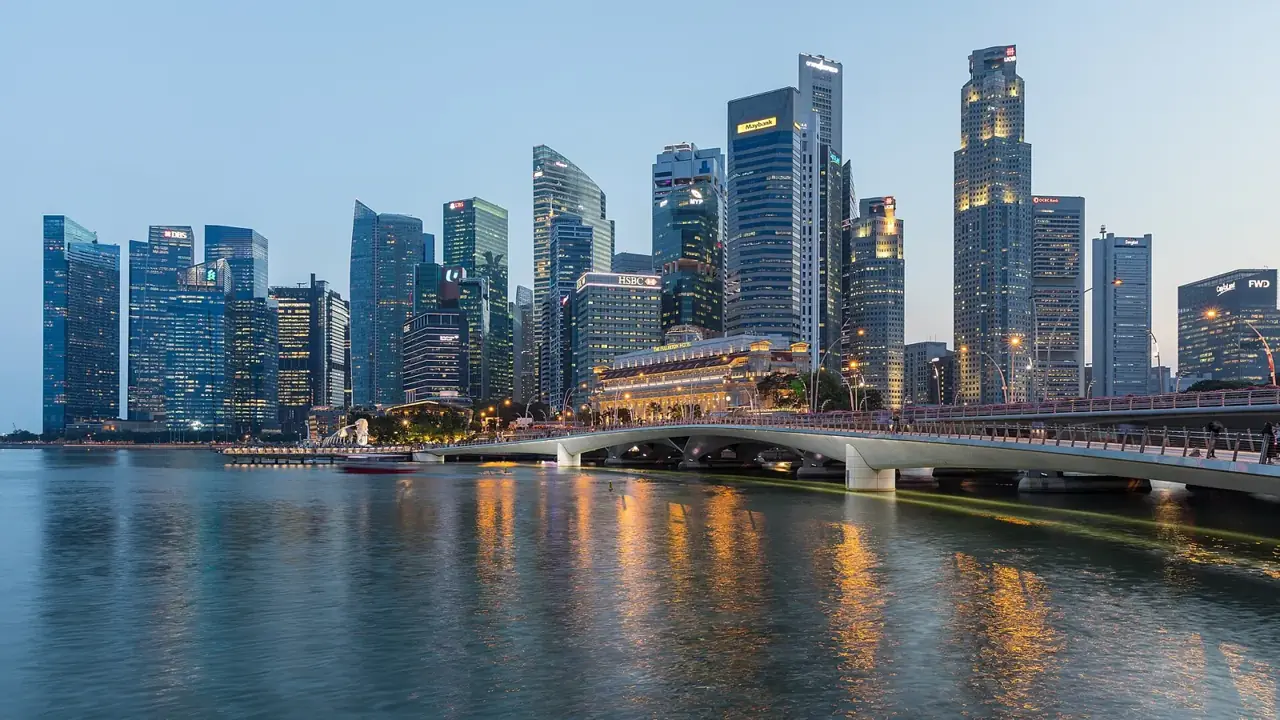
STI slips 0.43% to 4,953.81 as Hongkong Land shines and 15 stocks hit 52-week lows
Singapore's STI fell for a second session to 4,953.81 as Hongkong Land rose 2.38% on raised guidance, while Seatrium and Genting Singapore sank to fresh lows.

The Straits Times Index closed at 4,953.81 on Monday, down 21.36 points or 0.43%, its second straight decline. The session was worse than the finish suggests: the index traded as low as 4,893.58 in the morning before buyers trimmed the loss to 2.39 points below the intraday high.
Breadth on our watchlist was firmly negative, with 8 counters up against 23 down. The STI is now 14.62% below its 52-week high of 5,801.96, hit on 4 September, and it sits below both its 50-day and 200-day moving averages. The 14-day RSI of 24.1 puts the benchmark in oversold territory. Year to date, the index is still up 6.39%.
Monday’s softness followed a heavy week. According to the Securities Investors Association (Singapore), the AI-driven selloff that began on Wall Street and heavy selling in the banks pulled the STI to a five-month low last week, with the three local banks down between 5.4% and 7% over those five sessions.
Hongkong Land leads a short list of gainers
Hongkong Land (SGX: H78) topped the gainers, adding 2.38% to US$8.59 on volume about 1.3 times its 20-day average. The stock is quoted in US dollars on SGX and is now just 2.6% shy of its 52-week high of US$8.82.
The move extends a run that started with the group’s third-quarter trading update on 20 November. Underlying profit for the quarter was 38% higher year on year, helped by stronger contributions from Hong Kong Central and mainland China plus lower net financing charges. Management raised full-year guidance, guiding to mid-teens percentage growth in underlying profit for FY2026, up from 11% in the first half, and high-teens growth in earnings per share with buybacks helping.
The details behind the re-rating are worth noting. Core Central spot office rents rose 13.9% in the first nine months of 2026 and market vacancy in the submarket fell to 7.6% at end-September from 9.2% at end-June, while uncommitted vacancy in the group’s own portfolio dropped to 4.9%, below 5% for the first time since 2022. Capital recycling proceeds have reached US$4.2 billion, ahead of its US$4 billion target for end-2027, and the group has added US$100 million to its buyback, taking the total programme to US$750 million. Net gearing stood at 11%. The shares trade on a price-to-book of 0.59 with a 3.22% dividend yield.
Seatrium hits a fresh 52-week low
Seatrium (SGX: 5E2) fell 1.92% to S$1.53 and touched a 52-week low of S$1.49 in the morning. That is a 13.07% slide over five sessions and a 29.49% decline this year, leaving the stock on a price-to-book of 0.71 against a gross dividend yield of 1.92%.
The catalyst is a divided sell-side view after the group’s third-quarter business update on 19 November. Net order book stood at S$12.2 billion at end-September across 35 projects with deliveries stretching to 2033, and Seatrium has won S$1.7 billion of new orders so far this year. It also guided that FY2026 underlying net profit would be materially higher than the prior year.
The problem is the trend in that order book. UOB Kay Hian, which kept its hold call but cut its target to S$1.80 from S$2.30, noted the order book has fallen from S$17.8 billion at end-2025 and that more than 70% of its value sits in projects delivering beyond 2029. CGS International went further and downgraded the stock to hold, cutting its target to S$1.80 from S$2.60 and trimming FY2027 and FY2028 earnings forecasts by 11%. On the other side, DBS Group Research kept buy with a S$3.00 target, pointing to improving gross margins, and OCBC kept buy with a fair value of S$2.62.
Genting Singapore closes at its low
Genting Singapore (SGX: G13) was the biggest decliner among our selected names, down 2.78% to S$0.525, a 52-week low, on volume 1.4 times average. No fresh company announcement explained Monday’s move. The stock has been drifting lower since its third-quarter results on 13 November, when net profit fell 42% year on year on a 22% drop in gaming revenue, which the company attributed to weaker premium play. The shares now yield 7.41% and trade on a price-to-book of 0.78, down 27.59% this year.
CapitaLand Ascott Trust (SGX: HMN) slipped 2.41% to S$0.81 on volume 2.2 times its average, though we found no company-specific news behind the drop. It is worth noting the REIT is still up 1.25% over the past month.
Broad REIT weakness, and a heavy day for ComfortDelGro
The damage was widest in rate-sensitive REITs and property. Mapletree Industrial Trust (SGX: ME8U) fell 1.82% to S$1.62 and CapitaLand China Trust (SGX: AU8U) lost 1.72% to S$0.57, both at 52-week lows. Fifteen watchlist names set new 52-week lows, including Keppel, ComfortDelGro, Wilmar, Sheng Siong, CapitaLand Investment, City Developments, Mapletree Logistics Trust, Mapletree Pan Asia Commercial Trust, Frasers Logistics & Commercial Trust, Suntec REIT and Starhill Global REIT.
ComfortDelGro (SGX: C52) was the volume standout, with 22.9 million shares changing hands, 3.51 times its 20-day average, as the price fell 1.65% to S$1.19, another 52-week low. Phillip Securities’ research arm published a neutral call with a S$1.21 target on 16 November, noting that third-quarter adjusted profit after tax fell 12% year on year to S$46 million and that taxi operating earnings dropped 43% as Singapore’s taxi fleet shrinks. The company has been buying back shares, purchasing 292,000 at S$1.225 on 20 November, but that has not stopped the slide.
Among the other gainers, iFAST Corporation (SGX: AIY) rebounded 1.82% to S$7.29 after a 8.88% five-day slide, Venture Corporation (SGX: V03) added 0.5% to S$14.05, CapitaLand Ascendas REIT (SGX: A17U) rose 0.47% to S$2.13 and Jardine Matheson (SGX: J36) firmed 0.43% to US$60.75.
What to watch next
The macro backdrop improved slightly on Monday. October core inflation eased to 1.5% from 2.0% in September, and headline CPI slowed to 1.9% from 2.2%, with prices down 0.3% month on month, according to MAS and MTI. Core inflation came in below the 1.6% median in a Bloomberg survey and below DBS’s 1.7% forecast, which supports the case for MAS to stand pat on policy.
Two things matter more for the near term. First, US PCE inflation and PMI data due this week will shape expectations for the Fed’s next move, and that feed straight into Singapore bank margins and REIT valuations. Second, Citi has cut Singapore to underweight against Asean peers, arguing the STI trades three standard deviations above its mean versus the MSCI Asean Index and setting a 5,325 target for the first half of 2027, with banks, roughly 55% of the index, seen struggling as dividend yield spreads compress. Citi’s preferences lean towards SATS, Singtel, Yangzijiang and CapitaLand Integrated Commercial Trust.
With the index oversold but still 6.39% higher this year, the practical takeaway for investors is to watch whether the recent run of 52-week lows broadens further, and to treat dividend yields above 7% on some REITs as a question about distribution resilience rather than a signal on its own.
Sources
- STI Extends Losses, Hits Lowest Since April
- Heavy selling of AI stocks, banks dragged STI to 5-month low below 5,000 | Securities Investors Association (Singapore)
- Seatrium’s slowing order book weighs on sentiment despite improving margins
- Consumer Price Developments in October 2026
- ComfortDelGro Corp Ltd - Taxi fleet decline re-accelerates - StocksBNB
- COMFORTDELGRO CORPORATION LIMITED : 20-Nov-2026
- Hongkong Land guides for full year EPS growth to be in 'high teens' range